Inflammatory breast cancer doesn't normally show signs like distinct mass or lumps which generally occurs with other forms of breast cancer. The disease grows as nests or sheets that clog the lymph system under the skin. Often the symptoms are attributed to other diseases and thus the diagnosis may take a long time to occur.
Generally signs of inflammatory breast cancer includes:
* Pain in the breast, which is often mistaken as a breast infection and treated with antibiotics.
* Nipple retraction or discharge
* Skin changes in the breast area when the lymph vessels become blocked by the breast cancer cells. Discoloration, giving the breast a red, purple, pink or bruised appearance. Pink or reddened areas often with the texture and thickness, dimpling or ridges on the skin of the affected breast, similar to an orange peel.
* A bruise on the breast that doesn't go away
* Sudden swelling of the breast. Rapid change in the appearance of one breast, over the course of days or weeks
* Swelling of the lymph nodes under the arm or in the neck or above the collar bone on the affected side or below the collarbone. Thickness, heaviness or visible enlargement of one breast
* Itching of the breast, tenderness, pain or aching.
If these signs of inflammatory breast cancer continue for more than a week, it is advisable to make an appointment with your doctor who has experience with this disease.
Watch a video on Inflammatory Breast Cancer Symptoms
Showing posts with label Signs. Show all posts
Showing posts with label Signs. Show all posts

SIGNS OF BREAST CANCER IN WOMEN
The early signs of breast cancer are the most vital factors to discover early and to increase the surviving rates of the breast cancer victims. Knowing what are the signs of breast cancer in woman will help in early detection when these signs appear, treatments can then be done earlier. By doing regular and routine self-exams on our breasts to find any abnormalities like lumps, bruising or pitted skin. The chances to survive will be greater if you act earlier when you discover these signs.
The followings are what are the signs of breast cancer in woman:
Itching is one of the early signs of breast cancer in woman. Especially when it accompanies discharges from either one or both of the nipple. The nipples may become flatten or inverted, discolored to pink or red.
Bruising on the breast is also one of the early signs and symptoms of breast cancer in woman. Color may change without disappearing.
Swelling when not on menstruation, or feeling lumps may be the another early signs of breast cancer in young woman.
Effects like thickening skin under arms, ridges or dimpling skin are also the early signs of breast cancer in woman. Breast skin will look like an orange skin. Unusually warmth may be felt on the breast.
Whether you are young or old woman, regular and routine monthly self-exams are really suggested for early detection of the signs. Read more on how to check for lumps in breast.
The followings are what are the signs of breast cancer in woman:
Itching is one of the early signs of breast cancer in woman. Especially when it accompanies discharges from either one or both of the nipple. The nipples may become flatten or inverted, discolored to pink or red.
Bruising on the breast is also one of the early signs and symptoms of breast cancer in woman. Color may change without disappearing.
Swelling when not on menstruation, or feeling lumps may be the another early signs of breast cancer in young woman.
Effects like thickening skin under arms, ridges or dimpling skin are also the early signs of breast cancer in woman. Breast skin will look like an orange skin. Unusually warmth may be felt on the breast.
Whether you are young or old woman, regular and routine monthly self-exams are really suggested for early detection of the signs. Read more on how to check for lumps in breast.
Lumps In Breast
Lumps In Breast
Studies have shown that chances of breast cancer recovery increases when lumps in breast are detected early. Even though 9 out of 10 are non-cancerous breast lumps, it is still best to seek advice from a doctor.
Average breast lump size through regular mammograms is 1.1cm or smaller and the average breast lump size found by self-examination is 2.1cm. However, lumps sizes and breast cancer stages are not related.
What Do Breast Lumps Feel Like?
Breast lump will normally feel smooth and squishy, in some instances, breast lumps in women feels like a mass or heap of tissues which can be hard or soft. A hard lump points toward a breast cancer or malignant tumor while soft masses are generally of benign origin. Cancerous breast lumps have irregular surface and is generally immobile while benign breast lumps are usually smooth and mobile. Breast lumps can be located near the armpits, near the nipples and also look for lump at bottom of breast.
How To Check For Breast Lumps?
1. Look For Physical Changes
a. Stand in front of a mirror with your arms at the sides and look for:
- Any changes in each breast size and shape
- Any dimpling of the skin
- Any change in nipples appearance
- Any discharge from the nipples when it is squeeze gently
b. Repeats the breast check for lumps with your arms raised above or behind your head
c. Repeats the checking for breast lumps a third time, now with your hands on your hips and with chest muscles tensed
2. Feel For Physical Changes
a. Lie down with a pillow under your left shoulder and place your left hand under your head
b. Use the middle three fingers of the right hand and hold fingers flat to exam for lumps in the left breast
c. Press firmly using small circular movements to check for breast lumps
d. Check the entire breast, armpit and around the nipple where lumps can be located
e. Repeat the above checking steps using your left hand to check for breast lumps in the right breast.
This month is Breast Cancer Awareness month - "Early Detection Saves Lives, Saves Breasts".
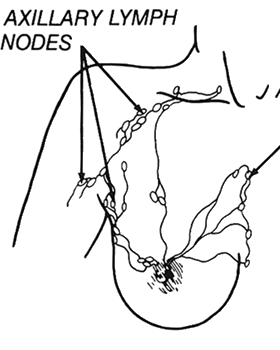
Breast Cancer Lymph Nodes
 |
| Breast Cancer Lymph Nodes |
Breast Cancer Lymph Nodes
Basically, there are three types of lymph node involvement in breast cancer:1. Minimal (or microscopic) lymph node involvement:
The lymph nodes are found with only a small number of cancer cells.
2. Significant (or macroscopic) lymph node involvement:
The cancer has spread to a particular lymph node or group of nodes and most of the time it can be felt by hand or seen without a microscope.
3. Extra-capsular lymph node extension:
The whole lymph node is taken over by a breast cancer tumor and spills beyond the wall of the lymph node into the surrounding fat.
Generally, the more extensive the lymph node involvement, the more aggressive the breast cancer will be. But the extent of disease within a particular lymph node is less important than the total number of lymph nodes affected. The more lymph nodes that are involved, the more threatening the breast cancer may be.
The following categories are used to describe the overall level of breast cancer lymph nodes involvement:
* no lymph nodes involved
* 1–3 nodes involved
* 4–9 nodes involved
* 10 or more nodes involved
Negative and Positive Breast Cancer Lymph Nodes:
If lymph nodes are clear of cancer, they are considered negative or clear, and rated N0. Lymph nodes are considered positive or cancerous and rated N1, N2, or N3 depending on the number affected and the location when it contain cancer cells or micro-metastasis. Rating positive breast cancer lymph nodes:
* N1: Cancer is found in 1-3 lymph nodes under the arm or lymph nodes within the breast
* N2: Cancer is found in 4-9 lymph nodes under the arm or lymph nodes within the breast
* N3: Cancer is found in 10 or more lymph nodes under the arm, or has spread under or over the collarbone. It may have been found in the underarm nodes as well as lymph nodes within the breast.
Determining whether the lymph nodes are free of cancer or not is an essential part of the breast cancer staging process and will help determine treatment and prognosis. Tumor size and the extent to which breast cancer has metastasized (spread) to other regions of the body is also examined.
| Stage | Tumor Size | Lymph Node Involvement | Metastasis (Spread) |
|---|---|---|---|
| I | Less than 2 cm | No | No |
| II | Between 2-5 cm | No or in same side of breast | No |
| III | More than 5 cm | Yes, on same side of breast | No |
| IV | Not applicable | Not applicable | Yes |
An axillary node dissection is a standard way to examine the lymph nodes. This procedure is normally done during the lumpectomy or mastectomy operation. It involves removing 10 to 30 lymph nodes for pathological examination using a microscope. The most common side effect of an axillary node dissection is lymph-edema (chronic swelling) of the arm, which may affect up to 10% of patients. Lymph-edema is caused when fluid to build up in the arm due to disruption or blocking of the normal process of draining lymph from the arm.
Sentinel node biopsy is another surgical option being used on selected breast cancer patients to determine whether breast cancer is present in the lymph nodes. A sentinel node biopsy involves removing only one to three sentinel lymph nodes (the first nodes in the lymphatic chain).
Signs of Breast Cancer
Oftentimes there are no significant signs of breast cancer that you can see or feel. If there are any significant signs, the more common ones are lump, which is an area of thickening, or a dimple in the breast. Less common signs include breast swelling up and inflammation or an fleshed out underarm lymph node.
However. it doesn't mean that you have breast cancer even if you have one or more of these signs. Most breast lumps turn out to be benign (not cancerous).
It is still very important that you consult your doctor immediately if you're worried that you might have breast cancer. Having your doctor's diagnosis will ease your worry, and if anything is found, you'll be able to take care of it promptly.
Physical examination of the breast is one way to uncovering breast cancer. Specific symptoms associated with breast cancer are
* lumps, redness, scaliness, or thickening of the nipple or breast skin
* nipple changes, nipple pain or the nipple turning inward
* cysts, nipple discharge other than breast milk
* breast pain, swelling of all or part of the breast and skin irritation or dimpling
These changes can be signs of less serious conditions that are not cancerous, such as an infection or a cyst. Early breast cancer usually does not cause pain.
A lump may be too small for you to feel or to cause any unusual changes initially. Normally, an unusual area turns up on a screening mammogram (x-ray of the breast), which results to further examination.
Commonly, the first sign of breast cancer is a new lump or aggregate in the breast that one can feel. A lump that is painless, hard, and has uneven edges is more plausible to be cancer. But sometimes cancers can be tender, soft, and rounded. So it's important to have anything abnormal ascertained by your doctor. Statistics show that 9 out of 10 breast lumps (90%) are benign.
Inflammatory breast cancer can look red and inflamed which could also cause soreness. Another rare type of breast cancer surfaces as rashes on and around the nipple. It is known as Paget's disease which appears a bit like eczema and is occasionally misidentified as that at first.
And you can read more about the breast cancer causes.
However. it doesn't mean that you have breast cancer even if you have one or more of these signs. Most breast lumps turn out to be benign (not cancerous).
It is still very important that you consult your doctor immediately if you're worried that you might have breast cancer. Having your doctor's diagnosis will ease your worry, and if anything is found, you'll be able to take care of it promptly.
Physical examination of the breast is one way to uncovering breast cancer. Specific symptoms associated with breast cancer are
* lumps, redness, scaliness, or thickening of the nipple or breast skin
* nipple changes, nipple pain or the nipple turning inward
* cysts, nipple discharge other than breast milk
* breast pain, swelling of all or part of the breast and skin irritation or dimpling
These changes can be signs of less serious conditions that are not cancerous, such as an infection or a cyst. Early breast cancer usually does not cause pain.
A lump may be too small for you to feel or to cause any unusual changes initially. Normally, an unusual area turns up on a screening mammogram (x-ray of the breast), which results to further examination.
Commonly, the first sign of breast cancer is a new lump or aggregate in the breast that one can feel. A lump that is painless, hard, and has uneven edges is more plausible to be cancer. But sometimes cancers can be tender, soft, and rounded. So it's important to have anything abnormal ascertained by your doctor. Statistics show that 9 out of 10 breast lumps (90%) are benign.
Inflammatory breast cancer can look red and inflamed which could also cause soreness. Another rare type of breast cancer surfaces as rashes on and around the nipple. It is known as Paget's disease which appears a bit like eczema and is occasionally misidentified as that at first.
And you can read more about the breast cancer causes.
Subscribe to:
Posts (Atom)
 Learn What Breast Cancer is and How to Deal with It.