Showing posts with label Stages. Show all posts

Breast Cancer Stage 2 Survival Rates

Breast Cancer Stage 2 Survival Rates
Breast Cancer Stages Survival Rates Chart

We have to accept the fact that not all patients who undergo breast cancer treatments are able to survive. So what is the breast cancer stage 2 survival rates?

The main differences between stage 1 and stage 2 breast cancer are that breast cancer cells may be present in the lymph nodes and any tumors within the breast are larger and more developed in stage 2. Stage 2 breast cancer is divided into two sub stages: 2A & 2B. Breast cancer stage 2A happens when the tumor is already 2 to 5 cm long. The Stage 2B refers to tumors more or less 2 cm long but some of the auxiliary lymph nodes are already affected.

Increasing Breast Cancer Stage 2 Survival Rates Treatment

    * Biological Therapy
    * Chemotherapy
    * Clinical Trials
    * Hormone Therapy
    * Radiation Therapy
    * Surgery

Today, the survival rates for breast cancer are 86% (for the 5-year period after diagnosis) and 76% (for the 10-year period). Breast cancer patients without metastatic has a rate of survival of 96% while those with metastatic has a rate of 21%. The percentage is based on the 5-year period after diagnosis. The established for breast cancer stage 2 survival rates within the 5-year period is 92% for Stage 2A  and Stage 2B is 81%.

Fortunately to increase breast cancer stage 2 survival rates, a lot of effort has been put to ensure that everyone has access to information in regards to early detection of breast cancer. Coupled with enhanced treatment for breast cancer stage 2, the survival rates for stage 2 breast cancer has increased over the last couple of years.

There are also studies which show a recurrence of roughly 10 percent in women who have suffered from stage 2 breast cancer and have managed to get rid of the cancerous cells. What is more is that, younger women have higher chances of surviving stage II breast cancer compared to older women.


 Prevention is also key to enhancing the breast cancer stage 2 survival rates. Practicing healthy lifestyle, for example, eating a well-balanced diet and avoiding junk and processed foods, regular exercises and minimizing alcohol consumption. According to recent studies carried out by CDC – Center for Disease Control and Prevention, the risk of stage 2 breast cancer advances with age. Therefore, leading a healthy lifestyle ensures that one is not prone to stage 2 breast cancer.

Lumps In Breast

Lumps In Breast


Studies have shown that chances of breast cancer recovery increases when lumps in breast are detected early. Even though 9 out of 10 are non-cancerous breast lumps, it is still best to seek advice from a doctor.

Average breast lump size through regular mammograms is 1.1cm or smaller and the average breast lump size found by self-examination is 2.1cm. However, lumps sizes and breast cancer stages are not related.

What Do Breast Lumps Feel Like?


Breast lump will normally feel smooth and squishy, in some instances, breast lumps in women feels like a mass or heap of tissues which can be hard or soft. A hard lump points toward a breast cancer or malignant tumor while soft masses are generally of benign origin. Cancerous breast lumps have irregular surface and is generally immobile while benign breast lumps are usually smooth and mobile. Breast lumps can be located near the armpits, near the nipples and also look for lump at bottom of breast.

How To Check For Breast Lumps?


1. Look For Physical Changes


a. Stand in front of a mirror with your arms at the sides and look for:
- Any changes in each breast size and shape
- Any dimpling of the skin
- Any change in nipples appearance
- Any discharge from the nipples when it is squeeze gently

b. Repeats the breast check for lumps with your arms raised above or behind your head

c. Repeats the checking for breast lumps a third time, now with your hands on your hips and with chest muscles tensed

2. Feel For Physical Changes


a. Lie down with a pillow under your left shoulder and place your left hand under your head

b. Use the middle three fingers of the right hand and hold fingers flat to exam for lumps in the left breast

c. Press firmly using small circular movements to check for breast lumps

d. Check the entire breast, armpit and around the nipple where lumps can be located

e. Repeat the above checking steps using your left hand to check for breast lumps in the right breast.

This month is Breast Cancer Awareness month - "Early Detection Saves Lives, Saves Breasts".

Breast Cancer Lymph Nodes


Breast Cancer Lymph Nodes
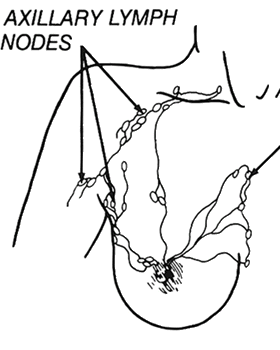
Lymph nodes is an important factor when staging breast cancer. Lymph nodes when containing the breast cancer cells factor the treatment determination, and predicting survival. Breast cancer cells are most commonly spreads first to the axillary (underarm) lymph nodes before spreading to other regions of the body.

Breast Cancer Lymph Nodes

Basically, there are three types of lymph node involvement in breast cancer:

1. Minimal (or microscopic) lymph node involvement:
The lymph nodes are found with only a small number of cancer cells.

2. Significant (or macroscopic) lymph node involvement:
The cancer has spread to a particular lymph node or group of nodes and most of the time it can be felt by hand or seen without a microscope.

3. Extra-capsular lymph node extension:
The whole lymph node is taken over by a breast cancer tumor and spills beyond the wall of the lymph node into the surrounding fat.

Generally, the more extensive the lymph node involvement, the more aggressive the breast cancer will be. But the extent of disease within a particular lymph node is less important than the total number of lymph nodes affected. The more lymph nodes that are involved, the more threatening the breast cancer may be.

The following categories are used to describe the overall level of breast cancer lymph nodes involvement:

* no lymph nodes involved
* 1–3 nodes involved
* 4–9 nodes involved
* 10 or more nodes involved

Negative and Positive Breast Cancer Lymph Nodes:
If lymph nodes are clear of cancer, they are considered negative or clear, and rated N0. Lymph nodes are considered positive or cancerous and rated N1, N2, or N3 depending on the number affected and the location when it contain cancer cells or micro-metastasis. Rating positive breast cancer lymph nodes:

* N1: Cancer is found in 1-3 lymph nodes under the arm or lymph nodes within the breast
* N2: Cancer is found in 4-9 lymph nodes under the arm or lymph nodes within the breast
* N3: Cancer is found in 10 or more lymph nodes under the arm, or has spread under or over the collarbone. It may have been found in the underarm nodes as well as lymph nodes within the breast.

Determining whether the lymph nodes are free of cancer or not is an essential part of the breast cancer staging process and will help determine treatment and prognosis. Tumor size and the extent to which breast cancer has metastasized (spread) to other regions of the body is also examined.

StageTumor SizeLymph Node InvolvementMetastasis (Spread)
ILess than 2 cmNoNo
IIBetween 2-5 cmNo or in same side of breastNo
III More than 5 cm Yes, on same side of breastNo
IV Not applicableNot applicable Yes

An axillary node dissection is a standard way to examine the lymph nodes. This procedure is normally done during the lumpectomy or mastectomy operation. It involves removing 10 to 30 lymph nodes for pathological examination using a microscope. The most common side effect of an axillary node dissection is lymph-edema (chronic swelling) of the arm, which may affect up to 10% of patients. Lymph-edema is caused when fluid to build up in the arm due to disruption or blocking of the normal process of draining lymph from the arm.

Sentinel node biopsy is another surgical option being used on selected breast cancer patients to determine whether breast cancer is present in the lymph nodes. A sentinel node biopsy involves removing only one to three sentinel lymph nodes (the first nodes in the lymphatic chain).

Breast Cancer Stages

Breast cancer stages are divided into four number of stages classified by stages of breast cancer development. The stages allows a better understanding of prognosis. The breast cancer staging are based on the size of the tumor, is the cancer is invasive or non-invasive, are there any lymph nodes are involved, and whether the cancer has spread beyond the breast or another part of the body.

The purpose for the staging system is to help organize the different factors and some of the personality features of the cancer into categories, in order to select the treatment (because treatment depends on the stage of disease) and in addition, the classification makes it possible to describe the breast cancer staging, so that was understandable to all doctors all over the world. The results of treatment based on this stages can be compare.

Breast Cancer Stages
Stage 0 (early stage)

Stage 0 is considered as a state used to describe non-invasive breast cancers. In stage 0, malignancy is localized in the breast tissue and there is no evidence of cancer cells or non-cancerous abnormal cells breaking out of the part of the breast, or of getting through to or invading neighboring normal tissue, and there are no signs of circulation to the lymph nodes.


Stage 1 describes invasive breast cancer, cancer cells are breaking through to or invading neighboring normal tissue) of breast cancer: Tumor size measures less than two centimeters, metastases to other organs and tissues are not available, no lymph nodes are involved.

Stage 2 breast cancer

described invasive breast cancer which is divided into subcategories known as 2A and 2B.
Stage 2A - Tumor is less than 2 cm in cross section with the involvement of the lymph node, or tumor from 2 to 5 cm without involvement of axillary lymph nodes. There are also cases no tumor can be found in the breast, but cancer cells are found in the axillary lymph nodes (the lymph nodes under the arm),

Stage 2B - Tumor is larger than 5 cm in cross section when the result of axillary lymph nodes research is negative for cancer cells or tumor from 2 to 5 cm in diameter with the involvement of axillary lymph nodes.

Stage 3 Breast Cancer


Described the invasive late (metastatic) stages of breast cancer when cancer cells spread to the lymph nodes and other tissues and is divided into subcategories known as 3A, 3B, and 3C.

Stage 3A (local spread of breast cancer) - tumor more than 5 cm with spread to axillary lymph nodes, or tumor of any size with metastases in axillary lymph nodes, which are knitted to each other or with the surrounding tissues, OR tumor is larger than 5 centimeters and has spread to axillary lymph nodes that are clumped together or sticking to other structures, OR no tumor is found in the breast. Cancer is found in axillary lymph nodes that are clumped together or sticking to other structures, or cancer may have spread to lymph nodes near the breastbone.

Stage 3B - Tumor of any size has spread or metastases into the skin, chest wall or internal lymph nodes of mammary gland (located below the breast inside of chest). May have spread to axillary lymph nodes that are clustered together or adhering to other structures, or cancer may have spread to lymph nodes near the breastbone. Inflammatory breast cancer is considered at this stage.

Stage 3C - Tumor of any size with a more widespread metastases and involvement of more lymph nodes. The cancer has spread to lymph nodes above or below the collarbone, and may have spread to axillary lymph nodes or to lymph nodes near the breastbone. There may be no sign of cancer in the breast.

Stage Four Breast Cancer


An invasive breast cancer defined as the presence of tumors (regardless of the sizes), spread to parts of the body that are located far from the chest which can involve the bones, lungs, liver, brain or distant lymph nodes.

Metastatic cancer is considered as stage 4. "Metastatic at presentation" - the breast cancer has spread beyond the breast and nearby lymph nodes, even though this is the first diagnosis of breast cancer. The reason for this is that the primary breast cancer was not found when it was only inside the breast.